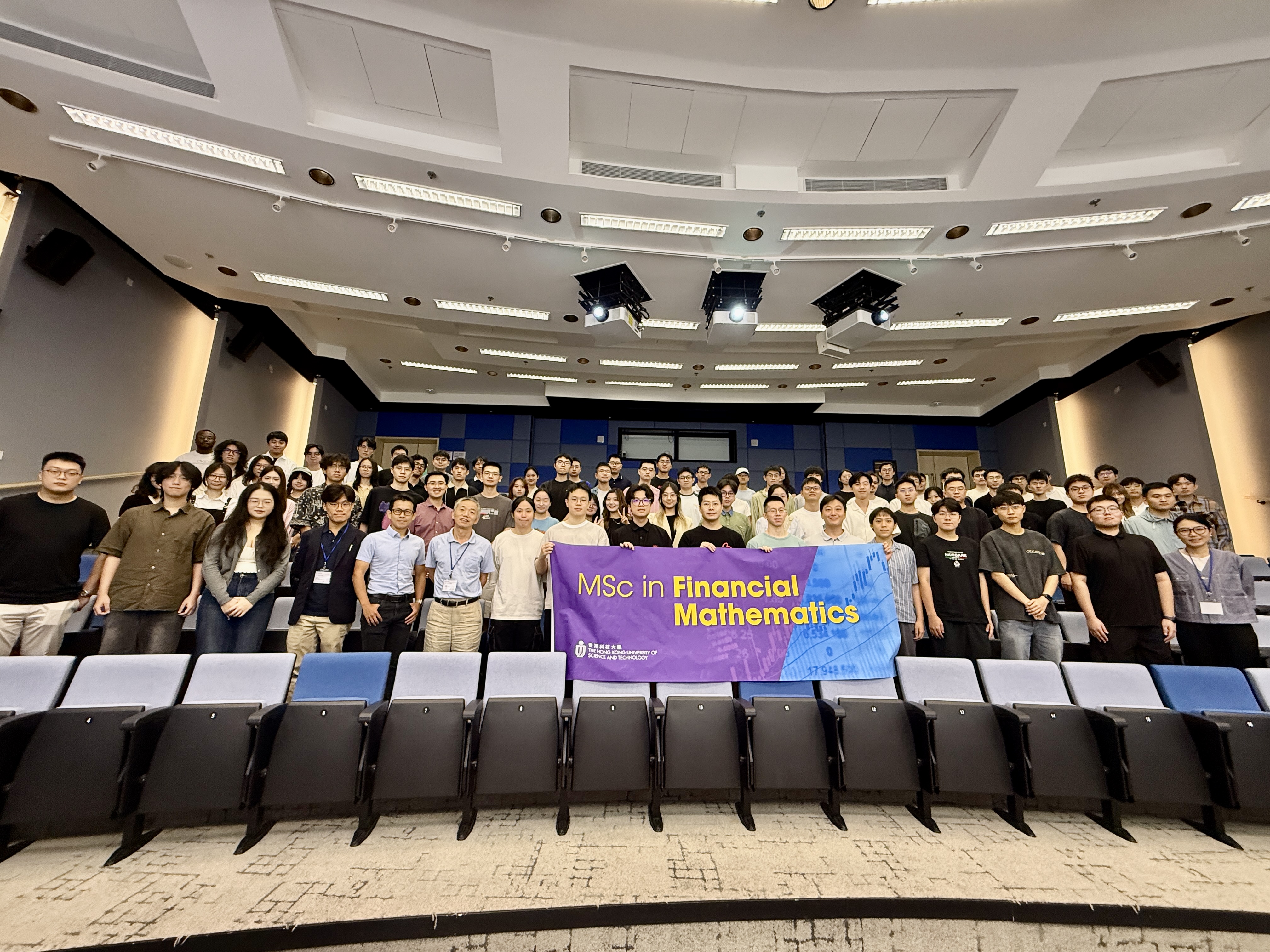
HKUST MSc in Financial Mathematics Orientation

Hong Kong University of Science and Technology
About the Course
MAFS6010H Quantitative Investment Systems: Data, AI, Portfolio Engineering and Execution (Winter 2026-27, Jan 2027) is taught by Dr. Don Huang at HKUST. The course equips students with a practical and systematic understanding of how mathematical, statistical, and computational models are transformed into real-world investment decisions in modern asset management. Rather than treating quantitative investing as a collection of isolated techniques, the course follows the complete investment decision chain:
Information → model → forecast → portfolio → trade → monitoring and validation.
A central theme is the gap between an idealized mathematical model and a deployable investment system: expected returns, covariance matrices, and machine-learning forecasts are estimated with error; portfolio solutions may be unstable; and an attractive theoretical strategy may perform very differently once turnover, liquidity, transaction costs, taxes, and execution are taken into account. Students learn not only how to construct a model, but how to challenge it, understand when it can be trusted, and determine whether it can survive real-world implementation.
Key Topics
- Point-in-time financial data and prevention of research leakage
- Data quality, survivorship bias, and look-ahead bias
- Factor investing and factor risk models
- Covariance estimation and risk modelling
- Estimation-aware, robust, and constrained portfolio optimization
- Benchmark-relative portfolio engineering
- Direct indexing and tax-loss harvesting
- Multi-period rebalancing under transaction costs and tax considerations
- Financial machine learning methods
- Large Language Models (LLMs) and AI-generated investment signals
- AI-assisted quantitative investment workflows
- Market impact, liquidity, and transaction cost analysis
- Optimal execution and implementation strategies
Quantitative Investment System Project
A major component of the course is a Quantitative Investment System Project, in which students design and develop a complete quantitative investment process integrating data management, signal generation, risk modelling, portfolio construction, implementation, and performance evaluation. Assessment emphasizes methodological soundness, robustness, transparency of assumptions, and practical deployability.
The course is designed for students interested in quantitative finance, asset management, financial data science, and AI-driven investment systems, and is suitable for students with backgrounds in mathematics, statistics, computer science, engineering, or finance. We warmly encourage eligible students to enroll and join us in this journey from data to deployable investment systems.